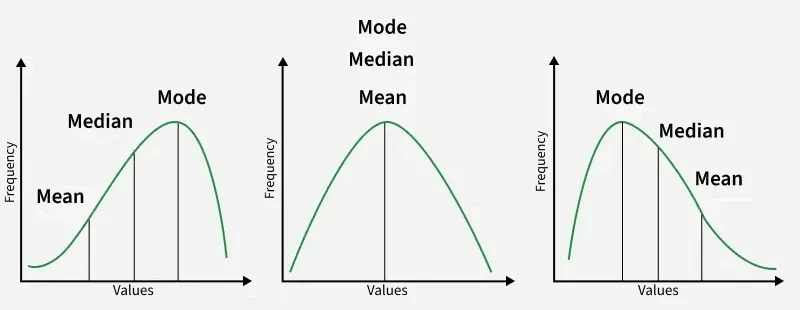
Introduction In the realm of statistics, measures of central tendency serve as fundamental tools for data analysis. The three primary measures—mean, mode, and median—provide insights into the characteristics of datasets. Understanding how to calculate and interpret these measures is crucial for researchers across various fields. This blog post aims to elucidate these concepts thoroughly, accompanied by practical examples and applications. ## Mean The mean, often referred to as the average, is calculated by summing all values in a dataset and dividing by the number of values. It represents a central point around which the data tends to cluster. ### Calculation of Mean The formula for calculating the mean is: [ \text{Mean} = \frac{\sum_{i=1}^{n} x_i}{n} ] Where: - ( x_i ) = each value in the dataset - ( n ) = total number of values ### Practical Example Consider the following dataset representing the ages of a group of individuals: 22, 25, 19, 30, 24 To calculate the mean: 1. Sum the values: ( 22 + 25 + 19 + 30 + 24 = 120 ) 2. Count the number of values: ( n = 5 ) 3. Calculate the mean: ( \text{Mean} = \frac{120}{5} = 24 ) Thus, the mean age of the group is 24 years. ### Application of Mean The mean is widely used in various fields such as economics, psychology, and health sciences. It provides a comprehensive measure of central tendency but can be influenced by outliers. For instance, in a dataset of incomes, a single high outlier can skew the mean significantly, making it less representative of the typical income. ## Mode The mode is the value that appears most frequently in a dataset. A dataset may have one mode, more than one mode, or no mode at all. ### Calculation of Mode To find the mode, follow these steps: 1. Identify the frequency of each value in the dataset. 2. Determine which value(s) occur most frequently. ### Practical Example For the dataset: 4, 1, 2, 2, 3, 4, 4 - The frequency of each value is: - 1 occurs 1 time - 2 occurs 2 times - 3 occurs 1 time - 4 occurs 3 times 4 is the mode, as it appears most frequently. ### Application of Mode The mode is particularly useful in categorical data analysis. For example, in market research, identifying the most popular product can be achieved through mode analysis. It is also applicable in situations where the average is not meaningful, such as determining the most common shoe size sold in a store. ## Median The median is the middle value in a dataset when the values are arranged in ascending or descending order. It is particularly useful for understanding the distribution of data, especially when outliers are present. ### Calculation of Median The calculation of the median varies depending on whether the number of values is odd or even. - If ( n ) is odd: [ \text{Median} = x_{(n+1)/2} ] - If ( n ) is even: [ \text{Median} = \frac{x_{n/2} + x_{(n/2) + 1}}{2} ] ### Practical Example For the dataset: 7, 3, 5, 1, 9 1. Arrange in ascending order: 1, 3, 5, 7, 9 2. Since there are 5 values (odd), the median is the third value: ( 5 ) For the dataset: 12, 15, 11, 14 1. Arrange in ascending order: 11, 12, 14, 15 2. Since there are 4 values (even), the median is: ( \frac{12 + 14}{2} = 13 ) Thus, the median age for the first dataset is 5, while for the second, it is 13. ### Application of Median The median is a robust measure of central tendency, particularly useful in skewed distributions. For instance, in income data where a few individuals earn significantly more than the rest, the median income provides a better representation of typical earnings compared to the mean. ## Conclusion In summary, the mean, mode, and median are essential statistical measures that help summarize and interpret data. While the mean provides an overall average, the mode highlights the most frequent values, and the median offers insight into the central position of the data. Each measure has its strengths and applications, making them invaluable in various research contexts. Understanding these concepts allows researchers to analyze data more effectively and draw meaningful conclusions from their findings.